
Personality, Status and Capacity in South African Law of Persons: A First-Year Student's Guide
A first-year guide to the South African Law of Persons, explaining the hierarchy from legal personality through status to capacity, with case law, legislation and practical examples.
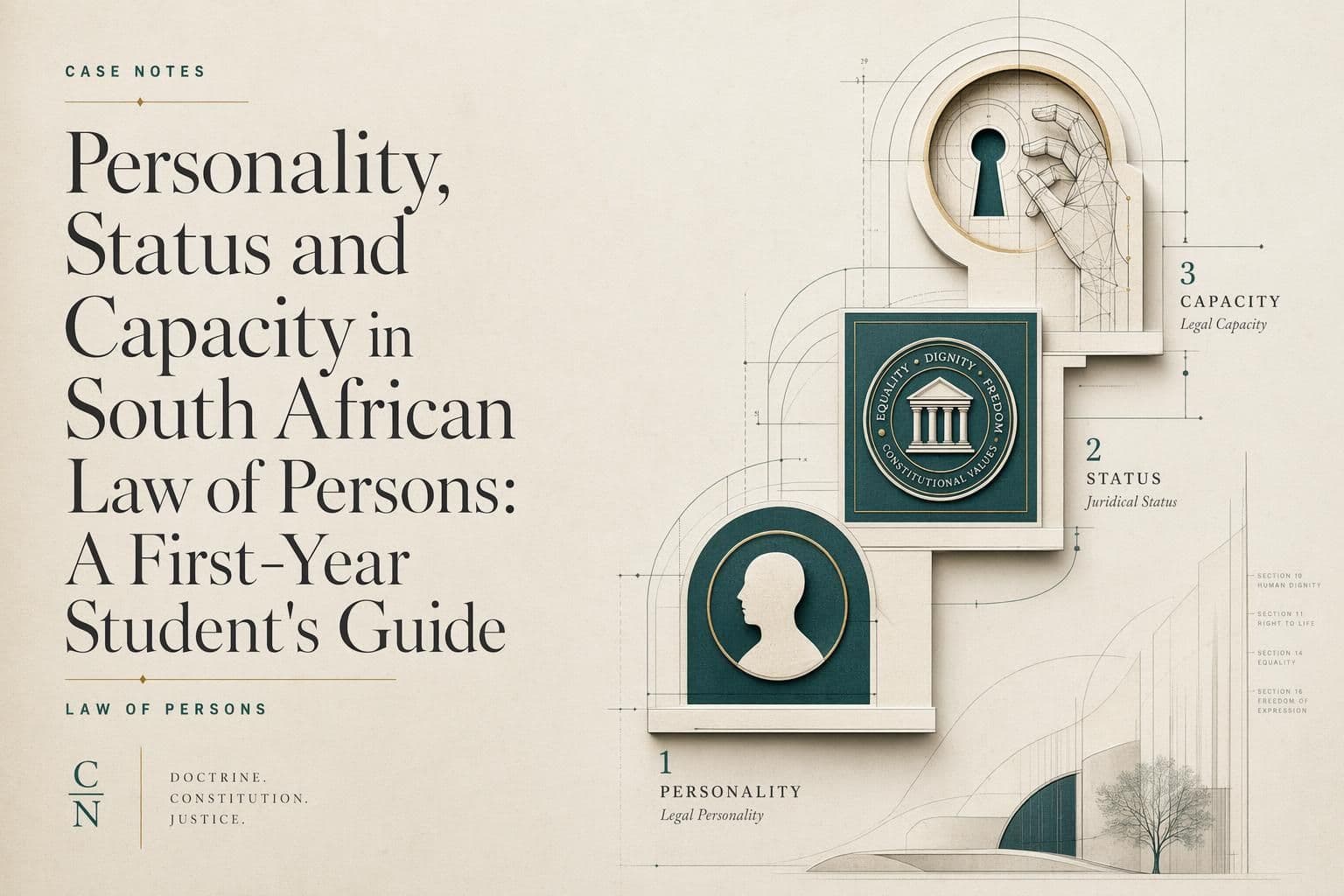
If you are starting your law degree in South Africa, one of the first modules you will encounter is the Law of Persons. At its core, this field regulates who counts as a legal subject, what class or group that subject belongs to, and what that subject can actually do in law.[^1] The three concepts - personality, status and capacity - form a simple hierarchy that every first-year student must master before moving on to Contract, Delict or Family Law. This article breaks that hierarchy down step by step, with the case law and legislation you need to know.
The Big Picture: Personality → Status → Capacity
Think of the Law of Persons as a series of three gates you must pass through before you can ask, "Can this person sue or be sued?"
GateQuestionExample1. PersonalityIs this entity a legal subject at all?A newborn baby? Yes. An unborn foetus? Only in limited circumstances. A dog? No.2. StatusWhat class or group does this legal subject belong to?Major or minor? Married or unmarried? Solvent or insolvent?3. CapacityWhat can this legal subject actually do?Can they enter a contract? Can they be held liable in delict?
A person's status (the second gate) determines their capacity (the third gate).[^2] Without personality, there is no status; without status, there is nothing from which capacity can flow.
1. Personality: The Foundation
Legal personality is the quality of being a legal subject - a bearer of rights, duties and capacities recognised by South African law.[^3] Only entities with legal personality can appear in court, own property, or enter contracts. South African law divides legal subjects into natural persons (human beings) and juristic persons (artificial entities such as companies and close corporations).
Natural Persons
A natural person acquires legal personality at birth and loses it at death. The Births and Deaths Registration Act 51 of 1992 makes the registration of every birth and death compulsory, which provides the official record of when personality begins and ends.[^4]
The nasciturus fiction. An unborn child (nasciturus) does not yet have legal personality. However, Roman-Dutch law developed a helpful rule: if a child is subsequently born alive, it is treated as already in existence whenever its own advantage is concerned.[^5] In Road Accident Fund v Mtati obo Zukhanye Mtati, the Supreme Court of Appeal confirmed this principle, allowing a claim on behalf of a child who had been injured before birth.[^6] The Constitutional Court later endorsed the same approach in H v Fetal Assessment Centre, clarifying that the "child" in this context means the child at the time of birth.[^7]
Death. Once a natural person dies, their legal personality is extinguished and personal liability cannot attach to them, although their estate may still be liable.[^8]
Juristic Persons
A juristic person is an artificial legal entity created by law. The most common examples are companies (governed by the Companies Act, 2008) and close corporations (governed by the Close Corporations Act 69 of 1984).[^9] A juristic person is separate and distinct from its members. In HRL Safari LLC v Forever Africa (Pte) Ltd, the court accepted as settled that a company is a juristic person distinct from its members, following the classic English authority of Salomon v Salomon & Co Ltd.[^10] The same principle was applied in Construction Resources Africa (Pty) Ltd v Central African Building and Construction Co (Pty) Ltd, where the court held that an artificial person can only litigate through an authorised natural person.[^11]
A Special Case: Trusts
Trusts do not have legal personality, but they are recognised as legal entities sui generis (of their own kind) and can sue and be sued in certain contexts.[^12] This is an important exam point: trusts are not juristic persons, yet they still have limited capacity to act.
2. Status: The Classification Layer
Once we know that an entity has legal personality, we move to the second gate: status. Status is a person's standing in the eyes of the law, determined by the class or group to which they belong.[^13] The law of persons is concerned primarily with the following status categories:
- Civil status - alive or dead; natural or juristic person.
- Marital status - unmarried, married in community of property, married out of community of property, or in a civil union.
- Family status - parent, child, guardian, spouse.
- Age status - major or minor.
- Mental health status - sound mind or mentally ill.
- Financial status - solvent or insolvent.
- Citizenship status - citizen or alien.
Marriage and Family Status
Marriage is a legal status with extensive consequences. In Volks NO v Robinson, the Constitutional Court examined the institution of marriage as a status that gives rise to reciprocal duties of support between spouses.[^14] South Africa now recognises multiple marriage regimes, each creating a different legal status:
- Civil marriages under the Marriage Act 25 of 1961.[^15]
- Customary marriages under the Recognition of Customary Marriages Act.[^16]
- Civil unions under the Civil Union Act, which provides that the legal consequences of a marriage under the Marriage Act apply equally to civil unions.[^17]
The legal status of marriage is not merely symbolic; it affects property rights, inheritance, tax and immigration. In Dawood v Minister of Home Affairs, the Constitutional Court discussed how marital status affects immigration rights, reflecting the diversity of South African families contracted under different legal regimes.[^18]
Majority and Minority
A "minor" is simply a person who has not yet achieved the legal status of majority.[^19] Age status is one of the most important categories because it directly affects capacity, which we discuss next.
3. Capacity: What a Legal Subject Can Actually Do
Capacity is the third and final gate. South African law distinguishes carefully between:
- Legal capacity (capacity to have rights) - the ability to be the bearer of rights and duties. All legal persons have this.
- Capacity to act (competence) - the ability to exercise those rights through one's own acts, such as entering a contract or incurring delictual liability.[^20]
A minor, for example, has legal capacity (they can own property and be the victim of a delict), but their capacity to act is limited (they generally cannot validly enter a contract without assistance).[^21]
The leading case on mental capacity to contract, Executive Hotel (Pty) Ltd v Bennett NO, confirmed that the question of capacity is one of fact for the court to decide. The court must assess whether, at the time of contracting, the person was able to understand the nature and consequences of the transaction.[^22]
Factors That Affect Capacity
The factors that affect capacity are, in essence, the factors that affect status - because capacity flows from status. Below are the most important ones for exam purposes.
(a) Minority
Minors generally lack full contractual capacity. The common law recognises exceptions for contracts relating to lawful necessaries (goods suitable to the minor's condition in life) and beneficial services (such as employment contracts that are objectively in the minor's interest).[^23]
In the litigation context, a minor's locus standi in judicio is limited: ordinarily, a minor cannot institute or defend proceedings without the assistance of a guardian.[^24] This protective principle was reinforced in Cameron Stewart Malcolm v Premier, Western Cape Government, where the court noted that laws relating to minors serve a protective purpose.[^25]
(b) Mental Illness
If a person suffers from a pathological disturbance of the mental faculties that prevents them from understanding the nature and consequences of a transaction, they lack contractual capacity.[^26] The Mental Health Care Act provides for the appointment of administrators to manage the property of mentally ill persons, and governs involuntary care and State patients.[^27]
(c) Insolvency
When a person's estate is sequestrated, their status changes to "insolvent." Their property vests in the trustee, and their contractual capacity to dispose of estate assets is restricted.[^28] The Insolvency Act governs these consequences.[^29] However, not all personal capacity is lost: an insolvent can still earn a salary and enter contracts relating to post-sequestration earnings, subject to certain limitations.
(d) Prodigality and Intoxication
Prodigality (habitual wasteful expenditure) can lead to the appointment of a curator, limiting the prodigal's capacity to manage property. Intoxication may temporarily deprive a person of contractual capacity if their understanding is sufficiently impaired. These are less commonly examined but remain part of the common law framework.
4. Putting the Hierarchy Together
Let us return to the three-gate model and test it with practical examples.
Example 1: A 17-year-old student buys a laptop
- Personality? Yes - she was born alive and is a natural person.
- Status? She is a minor (age status).
- Capacity? She lacks full contractual capacity. Unless the laptop is a lawful necessary or her guardian ratifies the contract, it is voidable at her option.
Example 2: A company enters a lease
- Personality? Yes - it is a juristic person registered under the Companies Act, 2008.
- Status? It is a registered company.
- Capacity? It has full legal capacity and capacity to act, provided the person signing on its behalf is authorised, as confirmed in ABSA Bank Ltd v SA Commercial Catering and Allied Workers Union National Provident Fund.[^30]
Example 3: A mentally ill person sells their house
- Personality? Yes - they are a natural person.
- Status? They have a mental health status that impairs capacity.
- Capacity? If they could not understand the nature of the sale, the contract is void, following the test laid down in Executive Hotel (Pty) Ltd v Bennett NO.[^31]
5. Summary and Exam Tips
For examination purposes, remember this hierarchy:
Personality (is there a legal subject?) → Status (what class?) → Capacity (what can they do?)
Key points to memorise:
- Legal personality begins at birth, ends at death, with the limited nasciturus exception.
- Companies are juristic persons separate from their members; trusts lack legal personality but have limited capacity.
- Status categories include age, marriage, mental health and solvency.
- Always distinguish legal capacity from capacity to act.
- The four main factors limiting capacity are minority, mental illness, insolvency and prodigality.
When answering a problem question, always work through the three gates in order. Do not jump straight to "Can X enter a contract?" without first establishing whether X is a legal subject and what status X holds.
Endnotes
[^1]: Law of persons in South Africa – Wikipedia.
[^2]: Law of Persons and Family (Pearson sample chapter).
[^3]: See generally UJ Law of Persons and Family.
[^4]: Births and Deaths Registration Act 51 of 1992.
[^5]: See Road Accident Fund v Mtati obo Zukhanye Mtati; Stewart v Botha.
[^6]: Road Accident Fund v Mtati obo Zukhanye Mtati.
[^7]: H v Fetal Assessment Centre.
[^8]: Costa NO v Arvum Exports (Pty) Ltd.
[^9]: Companies Act, 2008; Close Corporations Act 69 of 1984.
[^10]: HRL Safari LLC v Forever Africa (Pte) Ltd.
[^11]: Construction Resources Africa (Pty) Ltd v Central African Building and Construction Co (Pty) Ltd.
[^12]: Tusk Construction Support Services (Pty) Ltd v Independent Development Trust.
[^13]: Law of Persons and Family (Pearson sample chapter).
[^14]: Volks NO v Robinson.
[^15]: Marriage Act 25 of 1961.
[^16]: Recognition of Customary Marriages Act.
[^17]: Civil Union Act.
[^18]: Dawood v Minister of Home Affairs.
[^19]: Cameron Stewart Malcolm v Premier, Western Cape Government.
[^20]: See UJ Law of Persons and Family; Law of Persons and Family (Pearson sample chapter).
[^21]: See Linah Ntombi Madalane obo Clericia Masuku v Van Wyk.
[^22]: Executive Hotel (Pty) Ltd v Bennett NO.
[^23]: See generally Law of Persons and Family (Pearson sample chapter).
[^24]: Linah Ntombi Madalane obo Clericia Masuku v Van Wyk.
[^25]: Cameron Stewart Malcolm v Premier, Western Cape Government.
[^26]: See Simbarashe Mushambi Dube v Douglas Nzombe Chiutsi, confirming the test in Executive Hotel (Pty) Ltd v Bennett NO.
[^27]: Mental Health Care Act.
[^28]: See Liberty Group Ltd v Mohammed Shaaz Moosa.
[^29]: Insolvency Act.
[^30]: ABSA Bank Ltd v SA Commercial Catering and Allied Workers Union National Provident Fund.
[^31]: Executive Hotel (Pty) Ltd v Bennett NO.
References
Case Law
- ABSA Bank Ltd v SA Commercial Catering and Allied Workers Union National Provident Fund
- Cameron Stewart Malcolm v Premier, Western Cape Government
- Construction Resources Africa (Pty) Ltd v Central African Building and Construction Co (Pty) Ltd
- Costa NO v Arvum Exports (Pty) Ltd
- Dawood v Minister of Home Affairs
- Executive Hotel (Pty) Ltd v Bennett NO
- H v Fetal Assessment Centre
- HRL Safari LLC v Forever Africa (Pte) Ltd
- Liberty Group Ltd v Mohammed Shaaz Moosa
- Linah Ntombi Madalane obo Clericia Masuku v Van Wyk
- Road Accident Fund v Mtati obo Zukhanye Mtati
- Simbarashe Mushambi Dube v Douglas Nzombe Chiutsi
- Stewart v Botha
- Tusk Construction Support Services (Pty) Ltd v Independent Development Trust
- Volks NO v Robinson
Legislation
- Births and Deaths Registration Act 51 of 1992
- Civil Union Act
- Close Corporations Act 69 of 1984
- Companies Act, 2008
- Insolvency Act
- Marriage Act 25 of 1961
- Mental Health Care Act
- Recognition of Customary Marriages Act
Other Sources
Read more like this
New SA case analyses and study notes occasionally — never spam.