
Sentencing in South Africa: The Enduring Legacy of S v Zinn and Constitutional Evolution
An in-depth examination of South African sentencing law from the foundational S v Zinn triad through constitutional transformation, exploring landmark cases on minimum sentences, children's rights, and gender-based violence, with comprehensive analysis.
Introduction
Sentencing represents one of the most challenging and consequential exercises of judicial authority. It is the stage of criminal proceedings where abstract legal principles meet concrete human consequences—where courts must balance competing imperatives of punishment, deterrence, rehabilitation, and social protection while respecting human dignity and constitutional rights. In South Africa, sentencing jurisprudence reflects a fascinating evolution from pre-constitutional common law principles to a sophisticated constitutional framework that recognises both individual rights and societal interests.
At the heart of South African sentencing law lies S v Zinn 1969 (2) SA 537 (A), a pre-constitutional Appellate Division judgment that established the fundamental framework for sentencing—the "triad of Zinn." Despite its origins in the apartheid era, this framework has proven remarkably resilient, surviving the constitutional transition and remaining the foundational approach to sentencing more than five decades later. However, the advent of constitutional democracy in 1994 has profoundly reshaped sentencing law, introducing new considerations, constraints, and imperatives that courts must navigate.
This article examines the development of South African sentencing law from S v Zinn through the constitutional era. It explores how courts have interpreted and applied the Zinn triad in light of constitutional values; how legislative interventions (particularly minimum sentences legislation) have altered the sentencing landscape; and how constitutional rights—including the right to human dignity, protection against cruel punishment, and children's rights—have reshaped sentencing practice. Through analysis of landmark cases, the article demonstrates how sentencing law embodies the tension between crime control and human rights protection that characterises South Africa's criminal justice system.
The Pre-Constitutional Foundation: S v Zinn and the Sentencing Triad
The Zinn Framework
S v Zinn 1969 (2) SA 537 (A) established the fundamental principles that continue to guide sentencing in South Africa. While the case itself involved relatively minor offences (theft and receiving stolen property), the Appellate Division's judgment articulated a comprehensive framework for determining appropriate sentences that has achieved canonical status in South African law.
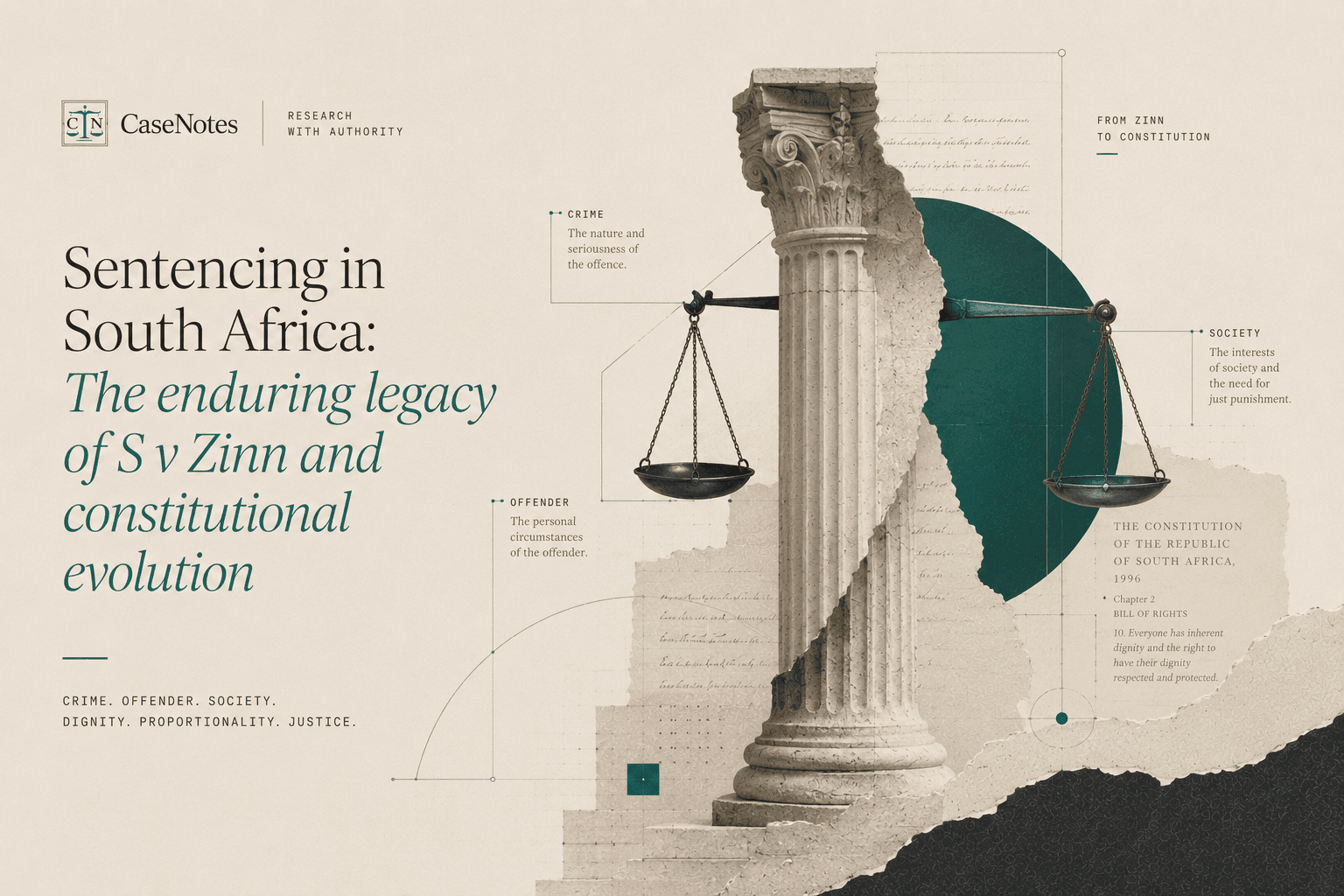
Holmes JA, writing for the Court, held that sentencing involves a balancing exercise requiring consideration of three factors:
-
The nature and circumstances of the offence: This includes the gravity of the crime, the manner of its commission, any violence or premeditation involved, the harm caused to victims, and the impact on society. Sentencing courts must assess what the particular offence reveals about its seriousness—not merely the formal legal categorisation, but the specific facts and context.[^1]
-
The personal circumstances of the offender: This encompasses the offender's age, health, employment status, family responsibilities, prior criminal record, character, prospects for rehabilitation, and any mitigating or aggravating factors relating to the individual. The principle of individualised sentencing requires that courts consider the specific person before them, not an abstract "typical offender."[^2]
-
The interests of society: This includes the need for general deterrence (deterring others from committing similar crimes), specific deterrence (preventing this particular offender from reoffending), retribution (societal condemnation and punishment proportionate to the wrongdoing), and protection of the public from dangerous individuals. Courts must consider what sentence serves the broader public interest and what message the sentence communicates about society's values.[^3]
The Zinn Court emphasised that these three factors are not separate compartments to be considered in isolation, but interconnected elements that must be balanced against each other. A sentence is appropriate when it properly weighs all three factors, giving due consideration to each without allowing any single factor to overwhelm the others inappropriately.[^4]
Judicial Discretion and Individualised Sentencing
Underlying the Zinn framework is the principle of judicial discretion. The Court recognised that sentencing cannot be reduced to mechanical formulas or rigid tariffs. Instead, sentencing requires the exercise of informed judicial judgment, considering the infinite variety of circumstances that characterise criminal conduct and those who commit it.[^5]
This discretion, however, is not unfettered. It is structured by the Zinn triad, constrained by statutory provisions (maximum penalties, certain mandatory minimum sentences even in the pre-constitutional era), and subject to appellate review. A sentencing court's discretion is properly exercised when it considers all relevant factors, excludes irrelevant considerations, and arrives at a sentence that falls within the range of sentences a reasonable court could impose in the circumstances.[^6]
The emphasis on individualised sentencing reflects a fundamental principle of justice: like cases should be treated alike, but different cases should be treated differently. Two persons convicted of the same statutory offence may deserve very different sentences depending on the circumstances of their particular conduct and their personal situations.[^7]
Pre-Constitutional Sentencing Objectives
While Zinn did not explicitly articulate a comprehensive theory of punishment, South African common law recognised several traditional objectives of sentencing:
Retribution: Punishment as desert—the notion that wrongdoing merits proportionate societal condemnation and suffering imposed on the offender. This reflects moral intuitions about justice and accountability.[^8]
Deterrence: Both general (discouraging others from similar conduct by demonstrating consequences) and specific (preventing this offender from reoffending through the experience of punishment or incapacitation).[^9]
Rehabilitation: Reforming the offender and reintegrating them into society as a law-abiding citizen. This objective recognises that most offenders will eventually return to society and that punishment should, where possible, facilitate positive change.[^10]
Protection of society: Incapacitating dangerous individuals to prevent them from harming others. This objective justifies lengthy or indefinite sentences for those who pose ongoing risks.[^11]
These objectives sometimes conflict, requiring courts to prioritise among them based on the circumstances. The Zinn framework provides a structure for this prioritisation through its balancing of offence, offender, and societal interests.
The Constitutional Transformation of Sentencing
The adoption of the Constitution of the Republic of South Africa, 1996, fundamentally transformed the legal landscape, including sentencing law. While the Zinn triad survived the transition and remains authoritative, constitutional rights and values have profoundly reshaped how courts approach sentencing.
Constitutional Rights Affecting Sentencing
Several constitutional provisions directly impact sentencing:
Section 9: Equality: The right to equality before the law and equal protection requires that sentencing not be arbitrary or discriminatory. Sentencing disparities based on race, gender, or other prohibited grounds violate constitutional equality guarantees.[^12]
Section 10: Human Dignity: The foundational value of human dignity requires that even convicted criminals be treated as bearers of inherent worth. Sentencing must respect the dignity of the person being sentenced, recognising their humanity even while imposing punishment.[^13]
Section 12(1)(e): Prohibition on Cruel, Inhuman, or Degrading Punishment: This provision explicitly constrains sentencing by prohibiting sentences that are excessively harsh, degrading, or disproportionate. It embodies the constitutional commitment that punishment, while often harsh, must remain within the bounds of human decency.[^14]
Section 28: Children's Rights: Section 28(2) provides that "a child's best interests are of paramount importance in every matter concerning the child." This provision has profound implications for sentencing, both when the offender is a child and when the offender is a primary caregiver of children. The landmark case M v The State [2007] ZACC 18 comprehensively addressed these implications, which are discussed in detail below.[^15]
Section 35(3)(o): Right to Appeal: This provision guarantees convicted persons the right to appeal or review by a higher court, ensuring that sentencing decisions are subject to scrutiny and correction if erroneous.[^16]
Restorative Justice and Ubuntu
The Constitution has also encouraged incorporation of restorative justice principles and the African philosophy of ubuntu into sentencing. Restorative justice emphasises repairing harm, reconciling offenders with victims and communities, and addressing underlying causes of offending behaviour. Ubuntu—the interconnectedness of humanity and the importance of community—provides a philosophical foundation for sentencing approaches that seek reintegration and healing rather than mere retribution.[^17]
While South African law has not fully embraced restorative justice as the dominant sentencing paradigm, constitutional values encourage courts to consider restorative approaches where appropriate, particularly through mechanisms like victim-offender mediation, community service, and reparation to victims.[^18]
The Zinn Triad in the Constitutional Era: Continuity and Evolution
Despite the constitutional transformation, the Zinn triad has retained its central position in sentencing jurisprudence. The Constitutional Court has repeatedly affirmed that Zinn provides an appropriate framework consistent with constitutional values, while recognising that constitutional rights may require additional considerations beyond the traditional triad.[^19]
Constitutional Elaboration of the Triad
Courts have interpreted each element of the Zinn triad through a constitutional lens:
The offence: Constitutional values influence assessment of offence seriousness. Crimes that violate constitutional rights (such as gender-based violence, hate crimes, or torture) are treated as particularly serious. The Constitutional Court has emphasised that South Africa's epidemic of violent crime, particularly gender-based violence, must inform sentencing for such offences.[^20]
The offender: Constitutional rights require heightened attention to offenders' personal circumstances, particularly regarding dignity, rehabilitation prospects, and the impact of punishment. Courts must consider whether imprisonment is necessary or whether alternative sentences (correctional supervision, community service, suspended sentences) might better serve constitutional objectives while protecting society.[^21]
Society's interests: In the constitutional era, "society's interests" encompass not merely crime control but also constitutional values like ubuntu, rehabilitation, and restorative justice. Society has an interest in both effective law enforcement and in ensuring that punishment respects human dignity and promotes reintegration where possible.[^22]
The Fourth Factor: Constitutional Rights as Independent Considerations
The Constitutional Court has clarified that certain constitutional rights require independent consideration beyond the traditional Zinn triad. These rights are not merely subsumed within "personal circumstances of the offender" but must receive specific, focused attention.
The most significant example is the right of children to have their best interests considered paramount (section 28(2)). In the landmark case M v The State [2007] ZACC 18, the Constitutional Court established that when sentencing a primary caregiver of minor children, courts must give specific, independent, and informed attention to the impact of imprisonment on the children.[^23]
M v The State: Sentencing Primary Caregivers and Children's Rights
M v The State [2007] ZACC 18 represents one of the most important sentencing judgments in the constitutional era, fundamentally reshaping how courts sentence primary caregivers.
Facts and Background
M, a 35-year-old single mother of three boys (aged 16, 12, and 8), was convicted of fraud and theft involving approximately R19,000. She had a prior conviction for fraud in 1996 (suspended sentence) and committed further fraud offences while on bail for a 1999 fraud charge. In 2002, the Wynberg Regional Court convicted her on 38 counts of fraud and 4 counts of theft, sentencing her to 4 years' direct imprisonment despite a correctional supervision report indicating she was a suitable candidate for non-custodial punishment.[^24]
After three months in prison, the High Court granted leave to appeal and bail. The High Court subsequently set aside one conviction and converted her sentence to imprisonment under section 276(1)(i) of the Criminal Procedure Act, allowing release under correctional supervision after 8 months. M appealed to the Constitutional Court, arguing that the sentencing courts failed to give adequate attention to the impact of imprisonment on her three minor children.[^25]
The Constitutional Court's Judgment
Justice Sachs, writing for the majority, held that section 28(2) of the Constitution creates enforceable rights requiring courts to give specific, independent, and informed attention to the impact of imprisonment on children of primary caregivers. The children's interests are not to be merely subsumed into consideration of the offender's circumstances but must be independently assessed.[^26]
The Court outlined a structured approach for sentencing primary caregivers:
-
Establish primary caregiver status: Determine whether the convicted person is a primary caregiver of minor children.
-
Ascertain the effect on children: If a custodial sentence is being considered, obtain adequate information (preferably through probation officer reports) about how imprisonment would affect the children.
-
If custodial sentence clearly appropriate: Ensure that adequate alternative care arrangements exist for the children. The Court cannot refuse imprisonment solely because it would harm children, but must ensure children's welfare is protected.
-
If non-custodial sentence appropriate: Determine the appropriate sentence bearing children's interests in mind.
-
If a range of sentences is appropriate: Use the paramountcy principle as an important guide to choose which sentence to impose.[^27]
Balancing Children's Interests with Other Factors
Critically, the Court clarified that while children's best interests are paramount, they are not absolute. Section 28(2) does not give primary caregivers immunity from imprisonment. Rather, it requires that children's interests be given primary consideration, which may be outweighed by other factors in serious cases.[^28]
The Court identified factors that may justify imprisoning a primary caregiver despite harm to children:
-
Seriousness of the offence: Particularly violent crimes or crimes causing substantial harm may require imprisonment regardless of impact on children.
-
Recidivism and lack of remorse: Persistent offending and absence of genuine reform suggest that non-custodial alternatives have failed and society's interests require incapacitation.
-
Adequate alternative care arrangements: Where close family members can care for children and the period of imprisonment is relatively short, the harm to children may be manageable.
-
Deterrence: Where a particular type of crime is prevalent and general deterrence is critical, imprisonment may be necessary despite harm to children.[^29]
The Minority Position
Justice Madala, writing for the minority (joined by two other judges), agreed with the general principles but would have upheld M's sentence. Madala J emphasised that primary caregivers cannot automatically escape imprisonment through their status. He noted M's recidivism (three separate fraud incidents), lack of genuine remorse, the seriousness of fraud as a crime, and the fact that alternative care arrangements existed for the children. The minority held that the High Court had adequately balanced competing interests and that eight months' imprisonment (with early release under correctional supervision) was appropriate despite the impact on the children.[^30]
Application to M's Case
The majority, however, found that neither the Regional Court nor the High Court had adequately considered the children's interests. The Regional Court's inquiry was perfunctory, and no probation officer's report was obtained. Given the comprehensive reports before the Constitutional Court showing that M had demonstrated an aptitude for productive life over seven years, was a devoted mother, and that imprisonment would collapse her business and harm the children, the Court imposed correctional supervision with conditions requiring repayment to victims, community service, and counselling.[^31]
Significance of M v The State
M v The State is significant for several reasons:
Constitutional interpretation: It demonstrates how section 28(2) creates enforceable legal obligations beyond the traditional Zinn triad, requiring courts to add a "fourth factor" when sentencing primary caregivers.[^32]
Correctional supervision as meaningful alternative: The judgment affirms that correctional supervision is not a "lenient" option but can be an exacting regime that better serves rehabilitation, reparation, and restorative justice objectives than imprisonment.[^33]
Practical guidance: The five-step framework provides clear guidance for sentencing courts, reducing arbitrariness and ensuring consistent application of constitutional rights.[^34]
Restorative justice: The judgment's emphasis on repayment to victims, community service, and rehabilitation reflects constitutional values of restorative justice and ubuntu.[^35]
Gender implications: By protecting children of primary caregivers (predominantly women), the judgment addresses indirect gender discrimination in sentencing while maintaining accountability for criminal conduct.[^36]
Minimum Sentences Legislation: Dodo and Legislative Sentencing Policy
The Criminal Law Amendment Act and Prescribed Sentences
In 1997, Parliament enacted the Criminal Law Amendment Act 105 of 1997, which introduced mandatory minimum sentences for specified serious crimes. Section 51 of the Act prescribes minimum sentences ranging from 5 years to life imprisonment, depending on the offence and circumstances. For example:
- Schedule 6 offences (murder, rape in certain circumstances, certain robbery, etc.): Life imprisonment
- Schedule 5 offences (other serious violent crimes): 15 years for first offenders
- Schedule 4 offences: 10 years for first offenders[^37]
Critically, section 51(3)(a) provides a safety valve: courts may impose lesser sentences if they are "satisfied that substantial and compelling circumstances exist which justify the imposition of a lesser sentence."[^38]
This legislation represented a significant shift from the discretionary sentencing tradition embodied in Zinn, raising profound questions about the separation of powers, judicial independence, and the constitutionality of legislatively mandated sentences.
Buzani Dodo v The State: Upholding Minimum Sentences
The constitutional challenge to minimum sentences legislation reached the Constitutional Court in Buzani Dodo v The State CCT 1/01, decided 5 April 2001. The applicant had been convicted of murder in circumstances falling within Schedule 2 Part I of the Act, triggering the mandatory life sentence under section 51(1). The High Court declared section 51(1) unconstitutional on two grounds: (1) it violated the separation of powers by usurping judicial sentencing functions, and (2) it was inconsistent with section 35(3)(c) of the Constitution (right to trial before an ordinary court).[^39]
The Constitutional Court's Analysis
Justice Ackermann, writing for a unanimous Constitutional Court, declined to confirm the invalidity declaration. The Court's analysis addressed several fundamental issues:[^40]
Separation of powers: The Court held that South Africa's Constitution does not embody a strict separation of powers but rather a system of checks and balances that permits necessary interaction between branches while preventing over-concentration of power. The legislature has legitimate authority to determine what conduct should be criminalised and punished, including prescribing mandatory minimum sentences as part of sentencing policy and societal protection. The limit is that the legislature cannot compel courts to impose sentences that violate constitutional rights.[^41]
Judicial independence: The Court rejected the argument that legislative prescription of sentences compromises judicial independence. Judicial independence relates to institutional autonomy and freedom from interference in deciding cases, not to unlimited discretion in all aspects of adjudication. Provided courts retain authority to determine whether a sentence is constitutionally permissible, legislative guidance on sentencing policy does not violate judicial independence.[^42]
Constitutional constraints: The critical constraint on legislative sentencing power is section 12(1)(e)'s prohibition on cruel, inhuman, or degrading punishment. The Court adopted the "gross disproportionality" test from Canadian and US jurisprudence: a mandatory sentence violates section 12(1)(e) if it is grossly disproportionate to the offence, considering the nature and circumstances of the crime, the offender's personal circumstances, and societal interests. Mere disproportionality is insufficient; the disproportionality must be gross.[^43]
The "substantial and compelling circumstances" safety valve: The Court held that properly construed, section 51(1) read with section 51(3)(a) does not compel grossly disproportionate sentences because courts retain discretion to impose lesser sentences where "substantial and compelling circumstances" exist. The Court endorsed the interpretation articulated by the Supreme Court of Appeal in S v Malgas [2001] ZASCA 30, which held that this phrase must be interpreted to permit departure from prescribed sentences where imposing them would be unjust and disproportionate.[^44]
S v Malgas and the Application of Minimum Sentences
S v Malgas [2001] ZASCA 30, decided shortly before Dodo, provided comprehensive guidance on applying the "substantial and compelling circumstances" provision. The Supreme Court of Appeal held:[^45]
-
The prescribed sentences represent Parliament's judgment about appropriate punishment for serious crimes and should not be departed from lightly or for flimsy reasons.
-
Courts should not use the pre-minimum-sentences sentencing approach as a baseline and then ask whether there are substantial and compelling circumstances to justify the prescribed sentence. Rather, the prescribed sentence is the starting point, and courts should ask whether there are substantial and compelling circumstances justifying a lesser sentence.
-
"Substantial and compelling circumstances" must be assessed objectively, considering all relevant factors, including mitigating and aggravating circumstances that might traditionally have led to a sentence other than the prescribed one.
-
The circumstances must be truly substantial (not trivial or marginal) and truly compelling (genuinely persuasive, not merely convenient).
-
Courts must articulate clearly what the substantial and compelling circumstances are and explain why they justify deviation from the prescribed sentence.[^46]
Malgas has been consistently followed and applied, establishing the framework for implementing minimum sentences legislation while retaining judicial discretion to avoid unjust outcomes.[^47]
Critique and Ongoing Debate
Minimum sentences legislation remains controversial. Supporters argue that it:
- Promotes consistency and reduces arbitrary disparities in sentencing
- Reflects democratic will through legislative policy on serious crime
- Protects society by ensuring serious offenders receive substantial punishment
- Responds to South Africa's high rates of violent crime[^48]
Critics contend that it:
- Undermines judicial discretion and individualised justice
- Produces harsh outcomes in exceptional cases
- Disproportionately affects poor and marginalised offenders who cannot afford sophisticated legal representation to establish "substantial and compelling circumstances"
- Reflects populist punitiveness rather than evidence-based policy
- Contributes to prison overcrowding without clear deterrent effect[^49]
The case law demonstrates courts navigating this tension, applying minimum sentences in typical cases while retaining flexibility to avoid gross disproportionality in exceptional circumstances.
Recent Developments: Peloeole and Gender-Based Violence
The Peloeole Case
Benedict Moagi Peloeole v The Director of Public Prosecutions, Gauteng Division, Pretoria (740/2022) [2022] ZASCA 117 illustrates contemporary application of minimum sentences in the context of gender-based violence—a critical issue in South African society.
Facts: In September 2015, Peloeole, a warrant officer in the VIP Protection Unit of the South African Police Service, fatally shot his wife and daughter with his service pistol at his home. Two nephews witnessed the shootings. The appellant's marriage had been turbulent, characterised by arguments about alcohol and suspected infidelity. He harboured resentment toward his wife and daughter, whom he perceived as disrespectful. After being convicted of two counts of murder, the High Court found the murders were premeditated but identified substantial and compelling circumstances justifying deviation from life imprisonment, sentencing him to 20 years on each count with 10 years concurrent (effective 30 years). Both parties appealed.[^50]
The Supreme Court of Appeal's Judgment
The Supreme Court of Appeal (per Mothle JA) upheld the finding of premeditation and set aside the 30-year sentence, imposing life imprisonment on each count. The Court's reasoning addressed several important issues:[^51]
Premeditation as aggravating factor: The Court clarified that premeditation is not an element of murder but an aggravating factor for sentencing purposes under section 51(1)(a) of the Criminal Law Amendment Act. Trial courts may properly pronounce on premeditation during sentencing proceedings rather than at conviction, provided the accused is not prejudiced and the proven facts establish premeditation beyond reasonable doubt.[^52]
Determining premeditation: While time between forming intent and execution is important, even a few minutes can suffice for premeditation where circumstances demonstrate deliberate weighing of the proposed criminal conduct. The evidence showed Peloeole harboured deep-seated resentment for months, calmly retrieved his firearm, executed the shootings methodically (four shots), returned the firearm to the safe, and left without rendering assistance. This established premeditation.[^53]
Rejection of mitigation: The Court rejected reliance on intoxication and emotional disturbance as substantial and compelling circumstances. The aggravating factors—vulnerability of victims, domestic setting, lack of remorse, continued threats to the surviving nephew—far outweighed mitigating factors (first offender, time in custody).[^54]
Gender-based violence: The judgment emphasised that the scourge of gender-based violence in South Africa has reached epidemic proportions and requires firm judicial responses. The Court held that the 30-year sentence was "shockingly inappropriate" given the gravity of domestic murder and the need to protect women and children.[^55]
Life imprisonment as appropriate response: While the High Court had discretion to deviate from the prescribed sentence if substantial and compelling circumstances existed, the Court found no such circumstances. Moreover, even if strict application of minimum sentences might not have applied, the Court held that courts retain inherent discretion to impose life imprisonment where the gravity of the offence warrants it.[^56]
Significance
Peloeole demonstrates several important principles:
Serious treatment of gender-based violence: The judgment reflects judicial recognition that domestic violence, particularly lethal violence against intimate partners and family members, must be met with severe punishment reflecting societal condemnation.[^57]
Limited scope for deviation: Courts should not readily deviate from prescribed minimum sentences for vague or ill-defined reasons. Only truly substantial and compelling circumstances justify lesser sentences for serious crimes.[^58]
Inherent judicial discretion: Even where prescribed minimum sentences may not strictly apply, courts retain inherent discretion to impose life imprisonment based on the gravity of the offence.[^59]
Premeditation in sentencing: The judgment provides valuable guidance on determining premeditation, emphasising that time is important but not determinative, and that circumstantial evidence may establish premeditated killing even where the actual execution is relatively swift.[^60]
Alternative Sentencing: Correctional Supervision and Restorative Approaches
While much sentencing jurisprudence focuses on imprisonment, South African law provides various alternative sentences that may better serve constitutional objectives in appropriate cases.
Correctional Supervision
Section 276(1)(h) and (i) of the Criminal Procedure Act 51 of 1977 provide for correctional supervision—a sentence served in the community under supervision rather than in prison. Conditions may include:
- House arrest or curfew
- Monitoring (including electronic monitoring)
- Community service
- Educational or vocational training programmes
- Counselling or rehabilitation programmes
- Compensation to victims
- Prohibition on alcohol or drug use[^61]
M v The State emphasised that correctional supervision is not a "lenient" alternative but can be an exacting regime that better serves rehabilitation, reparation, and restorative justice objectives than imprisonment. For offenders who pose no significant danger to society, correctional supervision may more effectively promote accountability, victim compensation, and reintegration while avoiding the criminogenic effects of imprisonment.[^62]
Suspended Sentences
Courts may suspend sentences wholly or partially, on condition that the offender complies with specified requirements (not reoffending, paying compensation, undergoing treatment, etc.). Suspended sentences provide a "Sword of Damocles"—a powerful incentive for compliance that avoids imprisonment if the offender demonstrates genuine reform.[^63]
Fines and Compensation Orders
Monetary penalties may be appropriate for less serious offences or where the offender's conduct caused primarily economic harm. Courts may order compensation to victims in addition to or instead of other punishment, serving both punitive and reparative functions.[^64]
Community Service
Community service sentences require offenders to perform unpaid work benefiting the community. This serves punitive, rehabilitative, and reparative functions—the offender experiences consequences, develops work habits and skills, and gives back to society.[^65]
Judicial Considerations in Choosing Alternatives
Courts consider several factors in determining whether alternative sentences are appropriate:
-
Seriousness of the offence: Serious violent crimes typically require imprisonment; less serious offences may be suitable for alternatives.
-
Risk to public safety: Dangerous offenders require incapacitation; low-risk offenders may be safely managed in the community.
-
Prospects for rehabilitation: Where genuine reform is likely, community-based sentences may be more effective than imprisonment.
-
Victim and societal interests: Some crimes (particularly violent crimes) require imprisonment to reflect societal condemnation, while others (particularly economic crimes) may be better addressed through compensation and reparation.
-
Offender's circumstances: Employed offenders with family responsibilities and community ties are better candidates for alternatives than those with no stabilising factors.[^66]
Sentencing Children and Young Offenders
Constitutional and Statutory Framework
Section 28 of the Constitution establishes comprehensive children's rights, including:
- Section 28(1)(g): Right not to be detained except as a last resort and for the shortest appropriate period
- Section 28(1)(h): Right to separate detention from adults and treatment appropriate to age
- Section 28(2): Best interests of children are paramount[^67]
The Child Justice Act 75 of 2008 implements these constitutional guarantees, establishing a comprehensive framework for dealing with children in conflict with the law (persons under 18 at the time of offending). The Act emphasises:
- Diversion: Removing children from the formal criminal justice system where possible through alternative accountability mechanisms
- Restorative justice: Emphasising repair of harm, reconciliation, and reintegration
- Last resort imprisonment: Detention and imprisonment only when absolutely necessary and for the shortest appropriate period
- Rehabilitation: Prioritising reform and reintegration over punishment[^68]
Sentencing Principles for Children
When sentencing children, courts must consider:
-
Age and maturity: Younger children and those with developmental delays bear less moral culpability than mature adults.
-
Circumstances leading to offending: Children often offend due to poverty, family dysfunction, peer pressure, or exploitation. Courts must address underlying causes.
-
Rehabilitation prospects: Children have greater capacity for change than adults and deserve opportunities for reform.
-
Impact of imprisonment: Imprisonment can have devastating developmental impacts on children, undermining education, family bonds, and psychological well-being.
-
Balancing with seriousness: Even children can commit very serious crimes (murder, rape). Courts must balance developmental considerations with gravity of harm caused and societal interests.[^69]
The Child Justice Act and minimum sentences legislation interact in complex ways. While minimum sentences apply to children convicted of Schedule 1, 2, and 3 offences, courts have greater latitude to find substantial and compelling circumstances for children, given section 28's constitutional mandate.[^70]
Sentencing for Multiple Offences: Cumulative vs. Concurrent Sentences
When an offender is convicted of multiple counts, courts must determine whether sentences should run concurrently (at the same time) or cumulatively (one after another), or some combination.
Principles Governing Multiple Sentences
Courts apply several principles:[^71]
Separate transactions principle: Offences arising from distinct occasions or separate criminal resolutions generally warrant cumulative sentences. For example, two unrelated robberies committed weeks apart typically receive cumulative sentences.
Single transaction principle: Offences arising from a single criminal episode typically warrant concurrent sentences or partial concurrency. For example, robbery and illegal firearm possession during a single incident might attract concurrent sentences.
Totality principle: The aggregate sentence must not be disproportionate to the overall criminality. Even if cumulative sentences are theoretically justified, courts may order partial concurrency to avoid an excessive total sentence.
One-law, one-punishment principle: The same conduct should not be punished twice. Where multiple convictions arise from identical conduct (e.g., theft and handling stolen goods for the same item), sentences should typically be concurrent.
Seriousness of criminality: More serious overall criminality warrants longer aggregate sentences. Prolific offending or a spree of crimes may justify fully cumulative sentences to reflect the scale of wrongdoing.
Recent case law confirms that courts have discretion to craft appropriate combinations of concurrent and cumulative sentences to achieve overall proportionality while adequately reflecting the totality of criminal conduct.[^72]
Appellate Review of Sentences
Grounds for Appellate Intervention
Sentencing is discretionary, and appellate courts generally defer to trial courts' sentencing decisions, recognising that trial courts have advantages (seeing and hearing witnesses, assessing offender demeanour, etc.) that appellate courts lack. However, appellate courts will intervene where:[^73]
Misdirection: The sentencing court:
- Considered irrelevant factors
- Failed to consider relevant factors
- Gave undue weight to certain factors
- Applied incorrect legal principles
- Made material factual errors
Gross disparity: The sentence is so disproportionate to the offence, offender, and societal interests that no reasonable court could have imposed it—it "induces a sense of shock" or is "startlingly inappropriate."[^74]
Constitutional violation: The sentence violates constitutional rights, particularly section 12(1)(e)'s prohibition on cruel, inhuman, or degrading punishment, or fails to properly consider constitutional imperatives like children's best interests under section 28(2).[^75]
Appellate Court Powers
When intervening, appellate courts may:
- Set aside the sentence and impose a different sentence
- Set aside the sentence and remit to the trial court for resentencing
- Confirm the sentence if the appeal is dismissed[^76]
Importantly, appellate courts exercise sentencing discretion afresh—they do not merely ask whether the trial court's sentence was reasonable, but determine what sentence they would impose based on all relevant factors.[^77]
Conclusion: Sentencing Law as Constitutional Balancing
South African sentencing law exemplifies the constitutional project of balancing competing values and interests. From the enduring foundation of the Zinn triad through the constitutional transformations embodied in cases like M v The State, Dodo, and Peloeole, sentencing jurisprudence demonstrates courts navigating profound tensions:
-
Individual rights vs. societal protection: Constitutional rights (dignity, protection from cruel punishment, children's best interests) must be balanced against society's legitimate interests in public safety, deterrence, and condemnation of serious wrongdoing.
-
Judicial discretion vs. legislative policy: The Dodo framework preserves judicial independence and discretion while respecting democratic authority to establish sentencing policy through minimum sentences legislation.
-
Punishment vs. rehabilitation: Sentencing must adequately denounce wrongdoing and deter future crime while recognising offenders' capacity for reform and the importance of reintegration.
-
Retribution vs. restorative justice: Traditional punitive objectives must be balanced with constitutional values emphasising ubuntu, human dignity, and healing of relationships disrupted by crime.
Several themes emerge from this analysis:
Resilience of foundational principles: S v Zinn's triad, articulated more than 50 years ago under a very different constitutional order, has proven remarkably adaptable to constitutional values. Its emphasis on balancing offence, offender, and societal interests provides a flexible framework compatible with constitutional rights.
Constitutional evolution: While the Zinn framework endures, constitutional rights have added new dimensions. Cases like M v The State establish that certain constitutional considerations (particularly children's rights) require independent attention beyond the traditional triad.
Legislative-judicial dialogue: Minimum sentences legislation and cases like Dodo and Malgas demonstrate productive dialogue between legislature and judiciary. Parliament legitimately establishes sentencing policy; courts retain authority to ensure sentences remain constitutionally permissible and individually just.
Context matters: Sentencing must be individualized, considering the infinite variety of criminal conduct and human circumstances. Rigid formulas or tariffs cannot capture this complexity—informed judicial discretion remains essential.
Ongoing challenges: South Africa faces profound challenges in sentencing: epidemic rates of gender-based violence requiring stern responses; prison overcrowding and degrading conditions undermining rehabilitation; resource constraints limiting alternatives to imprisonment; and persistent inequality in access to justice. Sentencing law alone cannot resolve these systemic issues, but it plays a critical role in embodying constitutional values within criminal justice.
For legal practitioners, judges, and students, understanding sentencing law requires appreciating both technical doctrines and underlying normative commitments. Sentencing is where criminal law meets human consequences most directly—where abstract principles of justice, dignity, and societal protection must be translated into concrete decisions about individual lives. The evolution from Zinn through the constitutional era demonstrates courts grappling seriously with this responsibility, seeking to develop sentencing law that is just, principled, and responsive to South Africa's unique challenges and constitutional aspirations.
As South African society continues to confront high crime rates, inequality, and the legacy of apartheid, sentencing jurisprudence will continue to evolve. The cases examined in this article provide a solid foundation, but new challenges will inevitably arise requiring courts to interpret constitutional values in novel contexts. The enduring lesson of Zinn and its constitutional successors is that sentencing requires careful balancing of competing considerations, informed judicial judgment, and unwavering commitment to both individual justice and societal well-being.
Bibliography
Cases
Buzani Dodo v The State CCT 1/01, decided 5 April 2001.
M v The State (CCT 53/06) [2007] ZACC 18.
Benedict Moagi Peloeole v The Director of Public Prosecutions, Gauteng Division, Pretoria (740/2022) [2022] ZASCA 117 (16 August 2022).
S v Malgas [2001] ZASCA 30; 2001 (2) SA 1222 (SCA); 2001 (1) SACR 469 (SCA).
S v Zinn 1969 (2) SA 537 (A).
Legislation
Child Justice Act 75 of 2008.
Constitution of the Republic of South Africa, 1996.
Criminal Law Amendment Act 105 of 1997.
Criminal Procedure Act 51 of 1977.
Books and Articles
Hoctor S 'Mandatory and Minimum Sentences: Considering S v Malgas' (2001) 14 South African Journal of Criminal Justice 208.
Skelton A 'Developing a Juvenile Justice System for South Africa: International Instruments and Restorative Justice' in Bezuidenhout C & Joubert S (eds) Child and Youth Misbehaviour in South Africa: A Holistic Approach (2nd ed, 2008) Van Schaik Publishers, Pretoria.
Terblanche S Guide to Sentencing in South Africa (3rd ed, 2016) LexisNexis, Durban.
Terblanche S 'Mandatory and Minimum Sentences in South Africa: Considering the Constitutionality of Different Interpretations' (2003) 16 South African Journal of Criminal Justice 34.
Van der Merwe A & Dawes A 'Youth Violence: A Review of Risk Factors, Causal Pathways and Effective Intervention' (2007) 20 Journal of Child and Adolescent Mental Health 95.
Van Zyl Smit D & Van der Spuy E 'Importing Criminological Ideas in a New Democracy: Recent South African Experiences' in Newburn T & Sparks R (eds) Criminal Justice and Political Cultures: National and International Dimensions of Crime Control (2004) Willan Publishing, Cullompton.
Sloth-Nielsen J & Gallinetti J 'Child Justice in Africa: A Rights-Based Approach' in Boezaart T (ed) Child Law in South Africa (2009) Juta, Cape Town.
Endnotes
[^1]: S v Zinn 1969 (2) SA 537 (A) at 540G-H.
[^2]: S v Zinn 1969 (2) SA 537 (A) at 540H-541A.
[^3]: S v Zinn 1969 (2) SA 537 (A) at 541A-B.
[^4]: S v Zinn 1969 (2) SA 537 (A) at 540G.
[^5]: S Terblanche Guide to Sentencing in South Africa 3 ed (2016) 137-140.
[^6]: Terblanche (n 5) 140-145.
[^7]: Terblanche (n 5) 151-154.
[^8]: Terblanche (n 5) 157-162.
[^9]: Terblanche (n 5) 162-168.
[^10]: Terblanche (n 5) 168-174.
[^11]: Terblanche (n 5) 174-177.
[^12]: Constitution of the Republic of South Africa, 1996, s 9.
[^13]: Constitution of the Republic of South Africa, 1996, s 10.
[^14]: Constitution of the Republic of South Africa, 1996, s 12(1)(e).
[^15]: M v The State (CCT 53/06) [2007] ZACC 18.
[^16]: Constitution of the Republic of South Africa, 1996, s 35(3)(o).
[^17]: D van Zyl Smit & E van der Spuy 'Importing Criminological Ideas in a New Democracy: Recent South African Experiences' in T Newburn & R Sparks (eds) Criminal Justice and Political Cultures: National and International Dimensions of Crime Control (2004) 184-208.
[^18]: Van Zyl Smit & Van der Spuy (n 17) 195-200.
[^19]: M v The State (n 15) para 18.
[^20]: Benedict Moagi Peloeole v The Director of Public Prosecutions, Gauteng Division, Pretoria (740/2022) [2022] ZASCA 117 para 44.
[^21]: M v The State (n 15) paras 32-35.
[^22]: M v The State (n 15) para 23.
[^23]: M v The State (n 15) para 26.
[^24]: M v The State (n 15) paras 1-5.
[^25]: M v The State (n 15) paras 6-10.
[^26]: M v The State (n 15) para 26.
[^27]: M v The State (n 15) para 36.
[^28]: M v The State (n 15) paras 20-24.
[^29]: M v The State (n 15) minority judgment per Madala J, paras 66-75.
[^30]: M v The State (n 15) minority judgment per Madala J, paras 77-84.
[^31]: M v The State (n 15) paras 56-63.
[^32]: M v The State (n 15) para 18.
[^33]: M v The State (n 15) paras 32-35.
[^34]: M v The State (n 15) para 36.
[^35]: M v The State (n 15) paras 60-62.
[^36]: J Sloth-Nielsen & J Gallinetti 'Child Justice in Africa: A Rights-Based Approach' in T Boezaart (ed) Child Law in South Africa (2009) 321.
[^37]: Criminal Law Amendment Act 105 of 1997, s 51.
[^38]: Criminal Law Amendment Act 105 of 1997, s 51(3)(a).
[^39]: Buzani Dodo v The State CCT 1/01 paras 1-5.
[^40]: Buzani Dodo v The State (n 39) paras 20-45.
[^41]: Buzani Dodo v The State (n 39) paras 27-32.
[^42]: Buzani Dodo v The State (n 39) paras 33-35.
[^43]: Buzani Dodo v The State (n 39) paras 36-42.
[^44]: Buzani Dodo v The State (n 39) para 43.
[^45]: S v Malgas [2001] ZASCA 30 paras 12-25.
[^46]: S v Malgas (n 45) paras 12-25.
[^47]: S Hoctor 'Mandatory and Minimum Sentences: Considering S v Malgas' (2001) 14 South African Journal of Criminal Justice 208.
[^48]: S Terblanche 'Mandatory and Minimum Sentences in South Africa: Considering the Constitutionality of Different Interpretations' (2003) 16 South African Journal of Criminal Justice 34, 42-45.
[^49]: Terblanche (n 48) 45-50.
[^50]: Benedict Moagi Peloeole v The Director of Public Prosecutions, Gauteng Division, Pretoria (n 20) paras 1-8.
[^51]: Benedict Moagi Peloeole v The Director of Public Prosecutions, Gauteng Division, Pretoria (n 20) paras 25-48.
[^52]: Benedict Moagi Peloeole v The Director of Public Prosecutions, Gauteng Division, Pretoria (n 20) paras 25-28.
[^53]: Benedict Moagi Peloeole v The Director of Public Prosecutions, Gauteng Division, Pretoria (n 20) paras 29-35.
[^54]: Benedict Moagi Peloeole v The Director of Public Prosecutions, Gauteng Division, Pretoria (n 20) paras 40-43.
[^55]: Benedict Moagi Peloeole v The Director of Public Prosecutions, Gauteng Division, Pretoria (n 20) para 44.
[^56]: Benedict Moagi Peloeole v The Director of Public Prosecutions, Gauteng Division, Pretoria (n 20) paras 45-48.
[^57]: Benedict Moagi Peloeole v The Director of Public Prosecutions, Gauteng Division, Pretoria (n 20) para 44.
[^58]: Benedict Moagi Peloeole v The Director of Public Prosecutions, Gauteng Division, Pretoria (n 20) para 40.
[^59]: Benedict Moagi Peloeole v The Director of Public Prosecutions, Gauteng Division, Pretoria (n 20) paras 45-48.
[^60]: Benedict Moagi Peloeole v The Director of Public Prosecutions, Gauteng Division, Pretoria (n 20) separate concurrence per Makgoka JA, paras 51-65.
[^61]: Criminal Procedure Act 51 of 1977, s 276(1)(h)-(i).
[^62]: M v The State (n 15) paras 32-35.
[^63]: Criminal Procedure Act 51 of 1977, s 297.
[^64]: Criminal Procedure Act 51 of 1977, s 300.
[^65]: Criminal Procedure Act 51 of 1977, s 297(1)(c).
[^66]: Terblanche (n 5) 385-420.
[^67]: Constitution of the Republic of South Africa, 1996, s 28.
[^68]: Child Justice Act 75 of 2008, ss 51-72.
[^69]: A Skelton 'Developing a Juvenile Justice System for South Africa: International Instruments and Restorative Justice' in C Bezuidenhout & S Joubert (eds) Child and Youth Misbehaviour in South Africa: A Holistic Approach 2 ed (2008) 435-452.
[^70]: Child Justice Act 75 of 2008, s 72.
[^71]: Terblanche (n 5) 442-465.
[^72]: Terblanche (n 5) 460-465.
[^73]: Terblanche (n 5) 493-505.
[^74]: Terblanche (n 5) 500-502.
[^75]: Terblanche (n 5) 502-505.
[^76]: Criminal Procedure Act 51 of 1977, ss 304, 309.
[^77]: Terblanche (n 5) 505-510.
Read more like this
New SA case analyses and study notes occasionally — never spam.