
Objective Law vs Subjective Law: A Practical Guide for SA Law Students
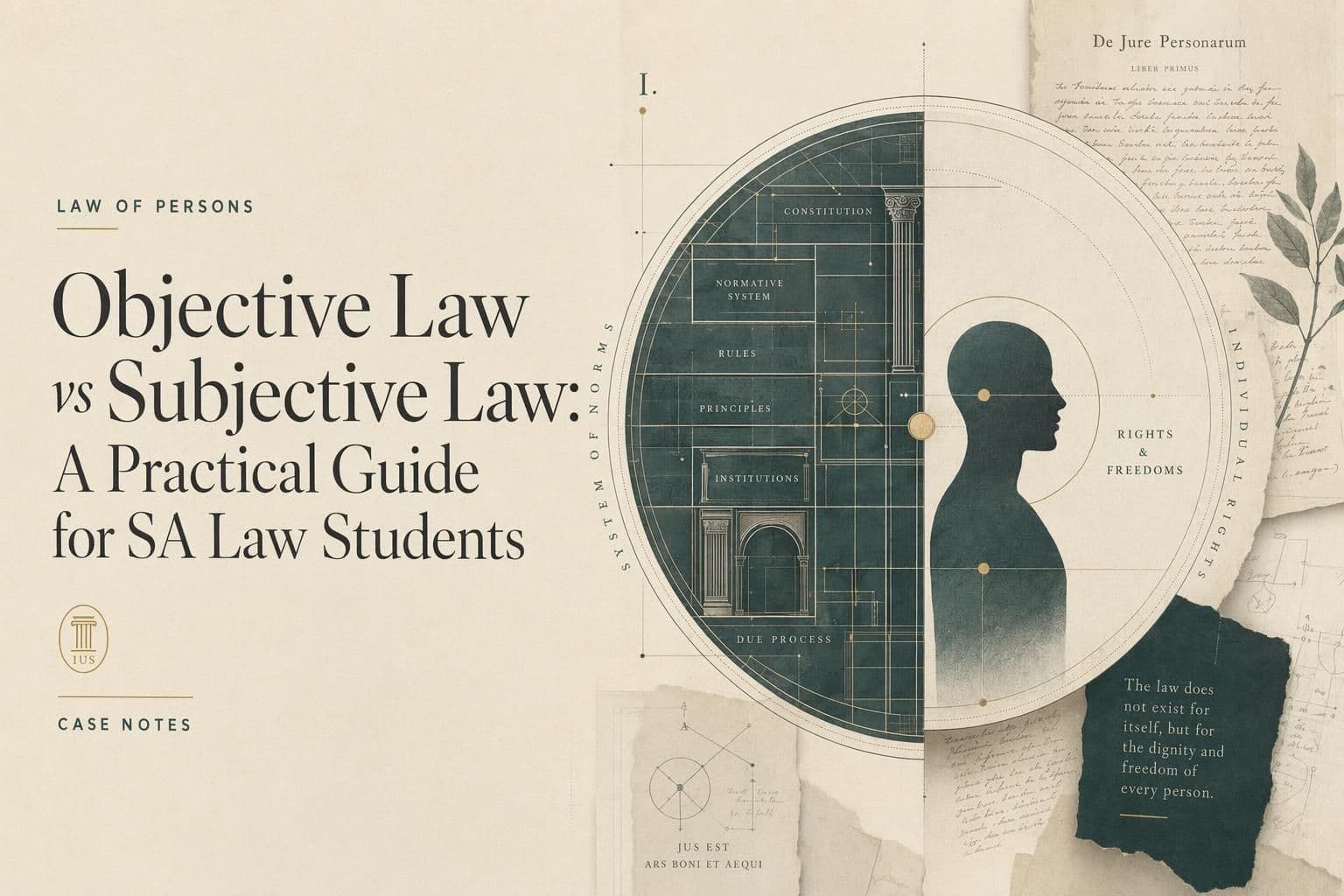
A practical educational guide for SA law students on the foundational distinction between objective law (the system of norms) and subjective law (individual rights) in the Law of Persons.
Introduction
One of the first conceptual hurdles in the South African Law of Persons is understanding that the word "law" describes two different things. In everyday conversation we say "the law says X" and "I have a right under the law." In legal theory, these two statements actually refer to two distinct concepts: law in the objective sense (objektiewe reg) and law in the subjective sense (subjektiewe reg).1
Grasping this distinction is not academic hair-splitting. It underpins how you analyse legal personality, determine who can sue or be sued, and classify the rights your client holds. This guide breaks the distinction down with definitions, examples, and the case law and textbook authority you need for exams.
What Is Objective Law?
Objective law is the entire system of legal norms and rules that governs society. It is "the law" as a body of positive law — the Constitution, legislation, common law, and customary law taken together.2 Objective law exists independently of any individual; it is the framework within which all legal subjects operate.
Think of objective law as the rulebook. It prescribes, permits, and prohibits conduct. It creates courts, defines crimes, and establishes the requirements for a valid contract. When your lecturer refers to "the South African legal system," they are talking about objective law.
Examples of objective law
- The Constitution of the Republic of South Africa, 1996 — the supreme legal norm.
- The Criminal Procedure Act 51 of 1977 — procedural rules for prosecutions.
- The common-law definition of murder or delictual liability.
In short: objective law is the system of norms.
What Is Subjective Law?
Subjective law is the network of legal relationships between members of the legal community. It concerns the rights (subjektiewe regte) that individual legal subjects hold and can enforce.3 While objective law is the rulebook, subjective law is the set of claims, powers, and privileges that those rules confer on people and juristic persons.
A simple way to remember it: objective law = rules; subjective law = my rights under those rules.
Example
Objective law says that ownership is protected. Your ownership of your laptop is a subjective right — a real right (ius in rem) enforceable against the world. The rule protecting ownership is objective law; the actual right you wield is subjective law.
The Two Core Relationships in Subjective Law
Subjective rights always involve two relationships:4
-
Subject–subject relationship The right exists between the right-bearer and other legal subjects, who bear a correlative duty. For example, your right to bodily integrity imposes a duty on every other person not to assault you.
-
Subject–object relationship The right exists between the right-bearer and the legal object of the right — the thing, performance, or aspect of personality over which the right is exercised.
Four Kinds of Subjective Rights
South African law recognises four principal categories of subjective rights, each with a distinct legal object:5
| Subjective Right | Legal Object | Example |
|---|---|---|
| Real right (ius in rem) | A corporeal or incorporeal thing | Ownership of a house |
| Personal right (ius in personam) | A performance by another (dare, facere, non facere) | A creditor's right to payment |
| Immaterial-property right | An intellectual product | Copyright in a song |
| Personality right | An aspect of one's own personality | The right to dignity and reputation |
These categories are not interchangeable. In problem questions, identifying whether a right is in rem or in personam determines the appropriate remedy and the parties you must cite.
Objective Law vs Subjective Law at a Glance
| Feature | Objective Law | Subjective Law |
|---|---|---|
| Nature | System of norms / rules | Network of legal relationships |
| Also called | Objektiewe reg | Subjektiewe regte |
| Key question | What does the law say? | What can I claim? |
| Scope | Applies to society as a whole | Attaches to individual legal subjects |
| Divided into | Public law and private law | Real, personal, intellectual, personality rights |
| Textbook anchor | Cronjé & Heaton, The South African Law of Persons6 | Van der Vyver & Joubert, Persone- en Familiereg7 |
The Link to Legal Subjectivity
The bridge between objective law and subjective law is legal subjectivity (regsubjektiwiteit). Legal subjectivity is the capacity to be a bearer of rights, duties, and competencies. It is conferred by objective law, but it is the precondition for holding any subjective right.8
Only a legal subject can hold subjective rights. Legal subjects fall into two classes:9
1. Natural persons
A human being becomes a legal subject at birth (total separation from the mother with independent life) and ceases to be one at death.10 The common-law position that murder requires the victim to have been born alive was confirmed in S v Mshumpa.11
2. Juristic persons
Associations and companies recognised by objective law as having independent legal personality. A juristic person can hold rights and duties distinct from its members and can sue and be sued in its own name.12 In Richard John Sibanda & 2 Others v The Apostolic Faith Mission, the court confirmed that an organisation clothed with legal personality has rights and duties independent of its own members.13
Because a juristic person is a legal person distinct from its members, it can only litigate through an authorised natural person.14 See Construction Resources Africa (Pvt) Ltd v Central African Building and Construction Co (Pvt) Ltd.
The Constitution of the Republic of South Africa, 1996 extends the Bill of Rights to juristic persons where applicable, taking into account the nature of the right.15 The Supreme Court of Appeal explored this in National Society for the Prevention of Cruelty to Animals v Minister of Justice and Constitutional Development, which dealt with whether the nasciturus fiction and related doctrines apply to juristic persons in constitutional litigation.16
Practical Examples for Problem Questions
Use these scenarios to test whether you can apply the distinction:
Scenario 1: Thabo signs a contract to buy a car from Lebo.
- The Consumer Protection Act 68 of 2008 (objective law) sets the rules for fair contract terms.
- Thabo's right to delivery of the car is a subjective personal right (ius in personam).
- Thabo's eventual ownership of the car will be a subjective real right (ius in rem).
Scenario 2: A newspaper publishes a defamatory article about a company.
- The common law of defamation is objective law.
- The company's right to its reputation is a subjective personality right. Whether juristic persons should be afforded the right to sue for defamation was discussed in Media 24 Ltd v SA Taxi Securitisation (Pty) Ltd.17
Scenario 3: A university senate amends its statutes.
- The Higher Education Act 101 of 1997 and the university's statute are objective law.
- The university, as a juristic person, has the subjective capacity to acquire rights and incur obligations in its own name.
Exam Checklist
When you see a Law of Persons question, run through this checklist:
- Identify the objective law: Which statute, common-law rule, or constitutional provision governs the issue?
- Identify the legal subjects: Are you dealing with natural persons, juristic persons, or both?
- Classify the subjective right: Is it real, personal, intellectual property, or a personality right?
- Identify the legal object: What is the right exercised over — a thing, a performance, an intellectual creation, or an aspect of personality?
Key Authorities
- Richard John Sibanda & 2 Others v The Apostolic Faith Mission — juristic personality and independent rights.
- Construction Resources Africa (Pvt) Ltd v Central African Building and Construction Co (Pvt) Ltd — litigation by juristic persons through natural representatives.
- National Society for the Prevention of Cruelty to Animals v Minister of Justice and Constitutional Development — application of constitutional rights to juristic persons.
- Media 24 Ltd v SA Taxi Securitisation (Pty) Ltd — scope of personality rights for juristic persons.
- Cronjé & Heaton, The South African Law of Persons — standard student textbook.
- Van der Vyver & Joubert, Persone- en Familiereg (3rd ed) — foundational Afrikaans authority on the distinction.
- Joubert WA, "'n Realistiese benadering van die subjektiewe reg" (1958) 21 THRHR 98–115 — seminal theoretical article.
- Van der Vyver JD, "Regsubjektiwiteit" (1973) 36 THRHR 266–273 — key article on legal subjectivity.
Conclusion
The distinction between objective law and subjective law is the scaffolding of the South African Law of Persons. Objective law is the system; subjective law is the set of rights that system creates. Every legal subject — natural or juristic — holds subjective rights by virtue of legal subjectivity conferred by objective law. Master this distinction, and you have the foundation for analysing legal personality, capacity, and human rights.
Endnotes
Footnotes
-
See generally Law of persons in South Africa — Wikipedia, available at https://en.wikipedia.org/wiki/Law_of_persons_in_South_Africa. ↩
-
Supra n 1. ↩
-
Supra n 1; see also Stellenbosch Class Notes — Objective Law and Subjective Rights, available at https://www.studocu.com/en-za/document/universiteit-stellenbosch/family-law/class-notes-on-subjective-rightsl/12082745. ↩
-
Supra n 1. ↩
-
Supra n 1. ↩
-
Cronjé & Heaton, The South African Law of Persons (Butterworths/LexisNexis); see https://www.scribd.com/document/877092027/The-South-African-Law-of-Persons-D-S-P-Cronje-J-Heaton-Z-Library-3. ↩
-
Van der Vyver & Joubert, Persone- en Familiereg (3rd ed, Juta 1991); see discussion in "Sir William Blackstone and the doctrine of subjective rights" (2023) 44 Obiter 151, available at https://scielo.org.za/scielo.php?pid=S1682-58532023000100010&script=sci_arttext. ↩
-
Supra n 1; see also "The Legal Nature of the Embryo" (2016) 19 PER/PELJ, available at https://perjournal.co.za/article/view/2914. ↩
-
Supra n 1. ↩
-
Supra n 1. ↩
-
S v Mshumpa — see discussion in Law of persons in South Africa — Wikipedia, supra n 1. ↩
-
Supra n 1. ↩
-
Richard John Sibanda & 2 Others v The Apostolic Faith Mission — SC 49/18. ↩
-
Construction Resources Africa (Pvt) Ltd v Central African Building and Construction Co (Pvt) Ltd — SC 110/22. ↩
-
Constitution of the Republic of South Africa, 1996, s 8(2). ↩
-
National Society for the Prevention of Cruelty to Animals v Minister of Justice and Constitutional Development — (20781/2014) [2015] ZASCA 206. ↩
-
Media 24 Ltd v SA Taxi Securitisation (Pty) Ltd — (437/2010) [2011] ZASCA 117. ↩
Read more like this
New SA case analyses and study notes occasionally — never spam.